

I was on the streets of Bologna, Italy. I had my wallet neatly zipped in my rear pocket and my phone in my front pocket with my hand on it – pretty safe, huh? When suddenly, out of the blue, a bicyclist turned and drove his bike between my legs. The hit jarred me, and I grabbed the handlebars.
The driver grabbed my one hand and started kissing it and apologizing. Realizing what was happening I reached my free hand toward my pockets only to find an unfriendly hand heading in the same direction. I pulled my other hand back from his make-out session and pushed him away. Score one for the good guys!
The second attempt was a little different. It occurred a few days later while on a call with another broker who told me we’d split a commission 50/50 per his agreement with the owner (which is the common standard). However, when I pressed to see their agreement or put it in writing how much we each would get paid, there was hesitation. The next thing I knew, the amount I was getting paid went up – guess we weren’t splitting 50/50 before!
Speaking of pickpocket attempts, you may have read about the so-called “mansion tax” that was implemented about three years ago in Los Angeles. If a property (not just a house, but land, commercial and apartments) sells for more than $5.4 million, the seller is taxed 4% of the closing price (this is price folks, not profit, not equity – even the loan amount is taxed). If it sells for more than $10.9 million, the tax increases to 5.5%. The tax was expected to raise $900 million a year, or $2.7 billion over its first three years. Instead, it brought in about $1.2 billion. A RAND study found that high-value sales dropped by an estimated 31% through early 2026, and apartment and commercial sales fell by more the 46%!
What’s worse, the tax has wiped out over 16,000 full-time construction jobs and 9,100 plus new home sales that would have had about 1,000 “affordable units” – the very thing the tax was meant to create. What’s even worse, the city spent just $114 million of the paltry $1.2 billion collected.
Taxing housing to pay for housing is like paying someone to break a window and then paying someone to fix it and calling it full employment!
So while government grinds itself into gridlock, what is going on in the market? High interest rates and inflation have put a real squeeze on tenants and have blunted investor interest, thereby slowing deal volume. Uncertainty and volatility are driving the pause and causing deal delays.
Investors are pulled in two very different directions. Ten-year Treasuries recently closed above 5% for the first time since 2007. So easy to put your money away for a risk-free return. On the other hand, a 10-year Treasury means commercial real estate loans are in the 6% – 7% range. With cap rates below those borrowing rates, investors don’t benefit from the leverage unless they have a way of reducing the expenses or increasing the income in short order.
Caught in the middle, CRE investment can feel harder to make or stick with. Why bother when Treasuries yield almost the same?
And don’t get me started on forever returns of the S&P 500 and NASDAQ 100 – almost all tied to AI!
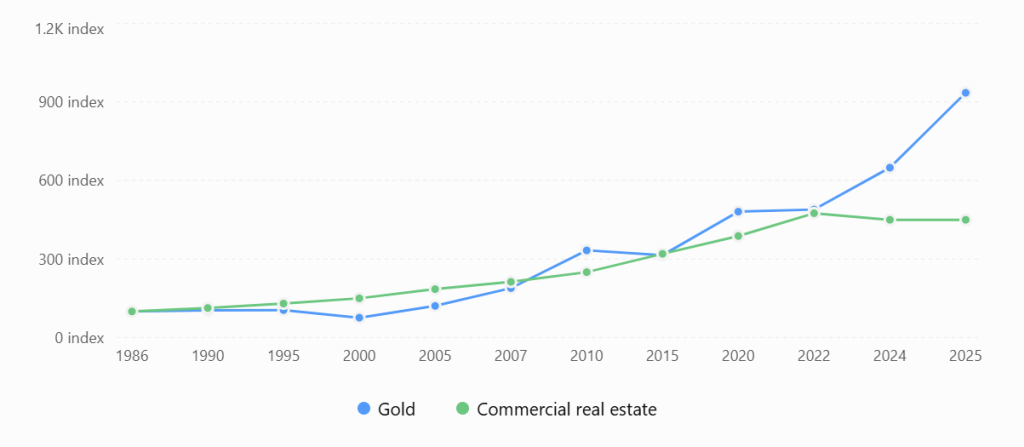
I am not much of a “gold bug,” but it is a hard asset and a way to measure on a daily basis the value of money not inhibited by the Fed. I like to think that real estate does the same. Because as the cost of bricks and mortar or rent go up, so does the eventual value of the real estate. What I like about real estate over gold is that despite its value going up and down over time, if it is well managed and producing income, you are receiving an income throughout the hopefully long history of holding the property. Gold doesn’t offer that.
Now here is my bombshell report …Over the last four years or so, CRE and gold have diverged. That means that gold is wrong or commercial real estate is undervalued. I think it is a little of both, but mostly CRE is undervalued. I’m not calling the bottom yet, but I think we are at the beginning of a buying opportunity. The only problem right now is that everyone is holding onto inventory, which is what is propping up the market for now.
One other thing that may be a coincidence or sign of the times. I have just seen title reports on two new deals and one was delinquent on its loan and the other on its property taxes . . . hmmm . . .
Nick’s Numbers
The chart below illustrates Don’s point about gold vs. CRE. This month I thought I would share a snippet from an email I had with a client about a property they wanted feedback on.
“Generally speaking, for industrial properties in Escondido, values were flat with slight appreciation from 2024 to 2025. From 2025 to 2026, there has been slight depreciation in values. The decline in 2026 is primarily attributable to various market pressures (higher interest rates, supply bottlenecks resulting from overseas conflicts, consumer confidence, etc.).
Values from 2024 to 2026 are probably fairly flat overall, with perhaps a slight decline.
If it is a leased income property, there are different considerations: interest rates vs. cap rates, term, and tenant replaceability confidence, etc.”
If you would like an analysis of your property’s value or discuss what you should be doing with regard to interest rates or inflation and their impacts on your business, tenants, or property, I’d be happy to talk. (Nick Zech, 858-232-2100, nzech@cdccommerical.com).
I know I wrote earlier about government gridlock. I recently saw this open letter from the city manager of Poway trying to explain why they are hamstrung by their own laws. You really should read it.
I just came back from Arizona where houses are half the price of San Diego. It’s easy to say they have deserts to keep building on. While that is true, in San Diego, back in the days before work from home, self-driving cars (and maybe even flying cars!), the planners, in all of their wisdom, decided we all needed to live downtown and near mass transit. They made almost all of the large swaths of land east of I-15 maximum of one house per 40 acres. Our housing crisis can largely be fixed with a stroke of a pen. Meantime, our bureaucrats are solving the problem by encouraging you to build 10 ADUs on your lots.
Meantime, I’m going to go back to herding cats. Hope you enjoy the story…
The Four Cats
Four men were bragging about how smart their cats were.
The first man was an Engineer,
The second man was an Accountant,
The third man was a Chemist, and
The fourth man was a Government Employee.
To show off, the Engineer called his cat, “T-square, do your stuff.”
T-square pranced over to the desk, took out some paper and pen and promptly drew a circle, a square, and a triangle.
Everyone agreed that was pretty smart.
But the Accountant said his cat could do better. He called his cat and said, “Spreadsheet, do your stuff.” Spreadsheet went out to the kitchen and returned with a dozen cookies. He divided them into four equal piles of three cookies.
Everyone agreed that was good.
But the Chemist said his cat could do better. He called his cat and said, “Measure, do your stuff.” Measure got up, walked to the fridge, took out a quart of milk, got a 10 ounce glass from the cupboard and poured exactly 8 ounces without spilling a drop.
Everyone agreed that was pretty good.
Then the three men turned to the Government Employee and said, “What can your cat do?”
The Government Employee called his cat and said, “Coffeebreak, do you stuff.” Coffeebreak jumped to his feet…
Ate the cookies…
Drank the milk…
Did his business on the paper. …
Had affairs with the other three cats…
Claimed he injured his back while doing so…
Filed a grievance report for unsafe working conditions…
Put in for Worker’s Compensation…
And went home for the rest of the day on sick leave…
AND THAT, MY FRIEND, IS HOW GOVERNMENT WORKS!!