
As the economy continues in “The Great Pause,” I know many are worried about the end of the world being near. What with war in Ukraine and the stand-off in Iran, along with top scientists missing or dead and Congress debating if “we are ready to learn about UFOs” – what more could go wrong? Well, I just read that worldwide wine consumption fell to its lowest level in over 60 years in 2024. I’ve heard the excuses: “the younger generation does CBD, therefore drinks less,” “people are getting more health-conscious,” etc…
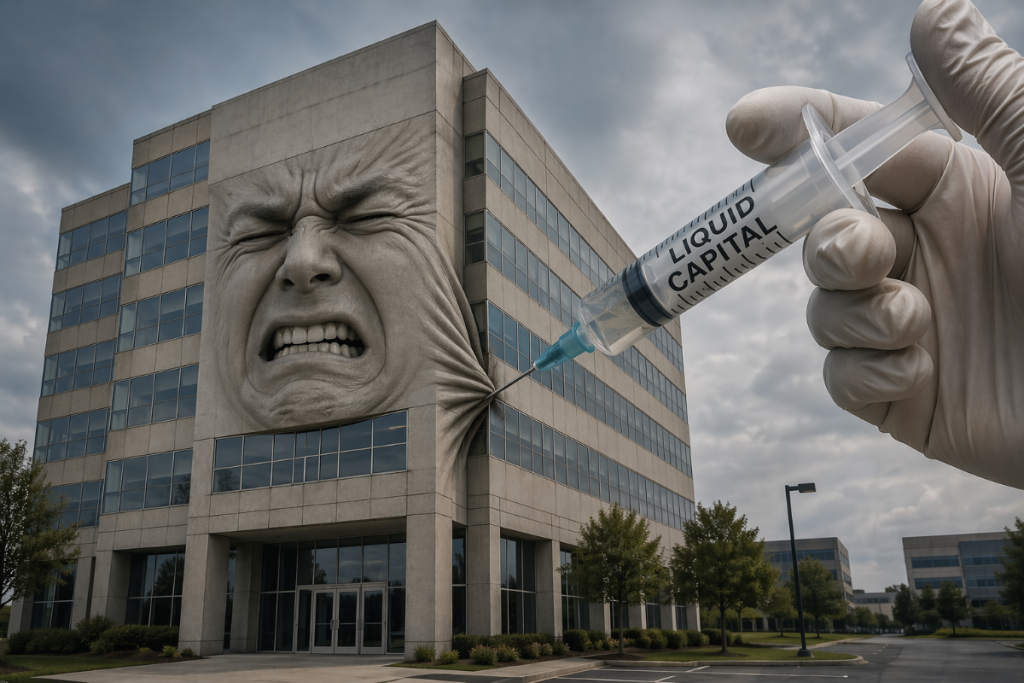
But it all became clear to me after a round of golf when 3 or 4 GLP/Ozempic users said they have lost their taste for alcohol since starting the regime. While I laud the loss of weight for these people, I began to question its impact on stocks and real estate. A quick look at Brown-Forman, the makers of Jack Daniel’s, shows they are down 60% since their high in 2020. Then I started looking at other less than healthy companies like fast food and soft drinks, even General Mills. They are all reeling as they pivot to meet demand for healthier products.
So what does this have to do with commercial real estate, you ask? Well, if you have a bar, a restaurant, or a grocery store and their normally high margin liquor and fast food sales are down 60%, they aren’t paying rent or at least not as much rent as they were. Decreases in rent mean a decrease in value, and therein is my conclusion that, yes GLP may have a sliming effect on CRE value. You may argue that this is only affecting a small portion of the market. I would argue back that in 2025 nearly half of retail leasing volume was food/beverage and discount retailers.
This month, I would like to give a little primer on rent, cash flow and cap rates. This is all brought about because of the following quote I read in a real estate article that I am still trying to process and fully understand.
“For investors, this shift in underwriting away from broad cycle-based assumptions and toward more granular analysis that separates current income direction, implied pricing and then forward expectations embedded in transaction activity.”
Commercial real estate can be confusing, especially when it comes to evaluating the performance and value of a property. The two most common metrics are cap rate and cash-on-cash. Cap rate is calculated by using the property’s one-year net operating income (NOI) and dividing it by the value or price of the property. Of course, anyone who took Algebra can tell you that if you don’t know the value of the property, you can divide the NOI by the cap rate to obtain the value. Usually, you can determine the cap rate by looking at what comparable properties sold for.
Cash-on-cash is determined by using the before-tax cash flow of a given year divided by the initial investment (down payment). It would be comparable to the “dividend” return of a stock. It represents the amount of cash an investor receives from their investment as a percentage of the cash they have invested. The biggest difference is that cash-on-cash takes into consideration the cost of financing.
The reason for this tutorial is for me to illustrate the fact that as interest rates go up cash-on-cash goes down and investors look at other investment options. This puts pressure on sellers to increase cap rates (which lowers the price of the property) so as to increase cash-on-cash and attract investors.
Now lesson two, rent. There are three types of rent that investors and brokers use.
- Current rent – what you are collecting now
- Economic rent – what the market says you should receive in rent
- Proforma rent – what the seller/broker represents to a buyer that they should be able to get.
There is often a significant variation in these rent types. First, a property owner’s goal is to maximize actual net operating income by increasing gross rent by having less vacancy and less expenses. Then the property owner does their taxes at the end of the year when they are interested in minimizing the income and maximizing the expenses to reduce the tax burden. Then the property owner loses interest in or mismanages the property, the rents go down because of vacancy and deferred maintenance. When the owner approaches the bank for financing, they get interested in maximizing the rents so it will appraise for more, hence a larger loan and maybe cash out.
When the property owner dies, their lawyer and accountant work feverishly to lower the value for inheritance taxes by showing lower rents and poor property conditions. Finally, the economy doesn’t continue to boom, or worse, goes into the tank, unemployment rises, vacancies rise and rents and values collapse. Then those proforma rents were simply someone’s optimistic opinion. Therein is your lesson on the real estate market!
Nick’s Numbers
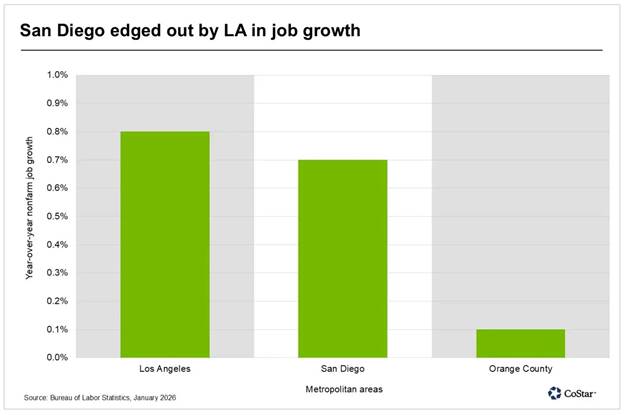
San Diego unemployment rate rose from 4.4% at the end of 2025 to 4.7% in January as reported by U.S. Bureau of Labor Statistics. 7,900 were trade and transportation with many tied to seasonal holiday employment. Leisure and hospitality fell by 3,100 jobs with nearly 75% in accommodation and food services (Don’s comment about GLPs?).
It’s bad enough when the Dodgers beat the Padres, but to edge us out in job growth is sad – see chart below.
An interesting note about the marketplace. Since 2020, nearly 3 million square feet of retail has been demolished in San Diego County. Over 400,000 square feet of retail was sold last year for housing redevelopment.
Lots of people invest based on perception. We try to help you with real income and real value decisions. When you earn income from an investment property, you can claim deductions for a wide range of expenses, such as mortgage interest, property taxes, insurance and ongoing maintenance and repairs. Real estate investors benefit from depreciation and can use tools like refinancing and 1031 exchanges to keep their capital compounding instead of cashing out. Hope you enjoy the story…
Perception
In Washington, DC, at a metro station, on a cold January morning in 2007, this man with a violin played six Bach pieces for about 45 minutes. During that time, approximately 2,000 people went through the station, most of them on their way to work. After about 3 minutes, a middle-aged man noticed that there was a musician playing, He slowed his pace and stopped for a few seconds, and then he hurried on to meet his schedule.
About 4 minutes later:
The violinist received his first dollar. A woman threw money in the hat and, without stopping, continued to walk.
At 6 minutes:
A young man leaned against the wall to listen to him, then looked at his watch and started to walk again.
At 10 minutes:
A 3-year-old boy stopped, but his mother tugged him along hurriedly. The kid stopped to look at the violinist again but the mother pushed hard and the child continued to walk, turning is head the whole time. This action was repeated by several other children, but every parent – without exception – forced their children to move on quickly.
At 45 minutes:
The musician played continuously. Only 6 people stopped and listened for a short while. About 20 gave money but continued to walk at their normal pace. The man collected a total of $32.
After 1 hour:
He finished playing and silence took over. No one noticed and no one applauded. There was no recognition at all.
No one knew this, but the violinist was Joshua Bell, one of the greatest musicians in the world. He played one of the most intricate pieces ever written with a violin worth $3.5 million. Two days before, Joshua Bell sold out a theater in Boston, where the seats averaged $100 each to sit and listen to him play the same music.
This is a true story. Joshua Bell, playing incognito in the DC metro station, was organized by the Washington Post as part of a social experiment about perception, taste and people’s priorities. This experiment raised several questions:
*In a common-place environment, at an inappropriate hour, do we perceive beauty?
*If so, do we stop to appreciate it?
*Do we recognize talent in an unexpected context? One possible conclusion reached from this experiment could be this:
If we do not have a moment to stop and listen to one of the best musicians in the world, playing some of the finest music ever written, with one of the most beautiful instruments ever made, how many other things are we missing as we rush through life?
Enjoy life NOW…it has an expiration date!